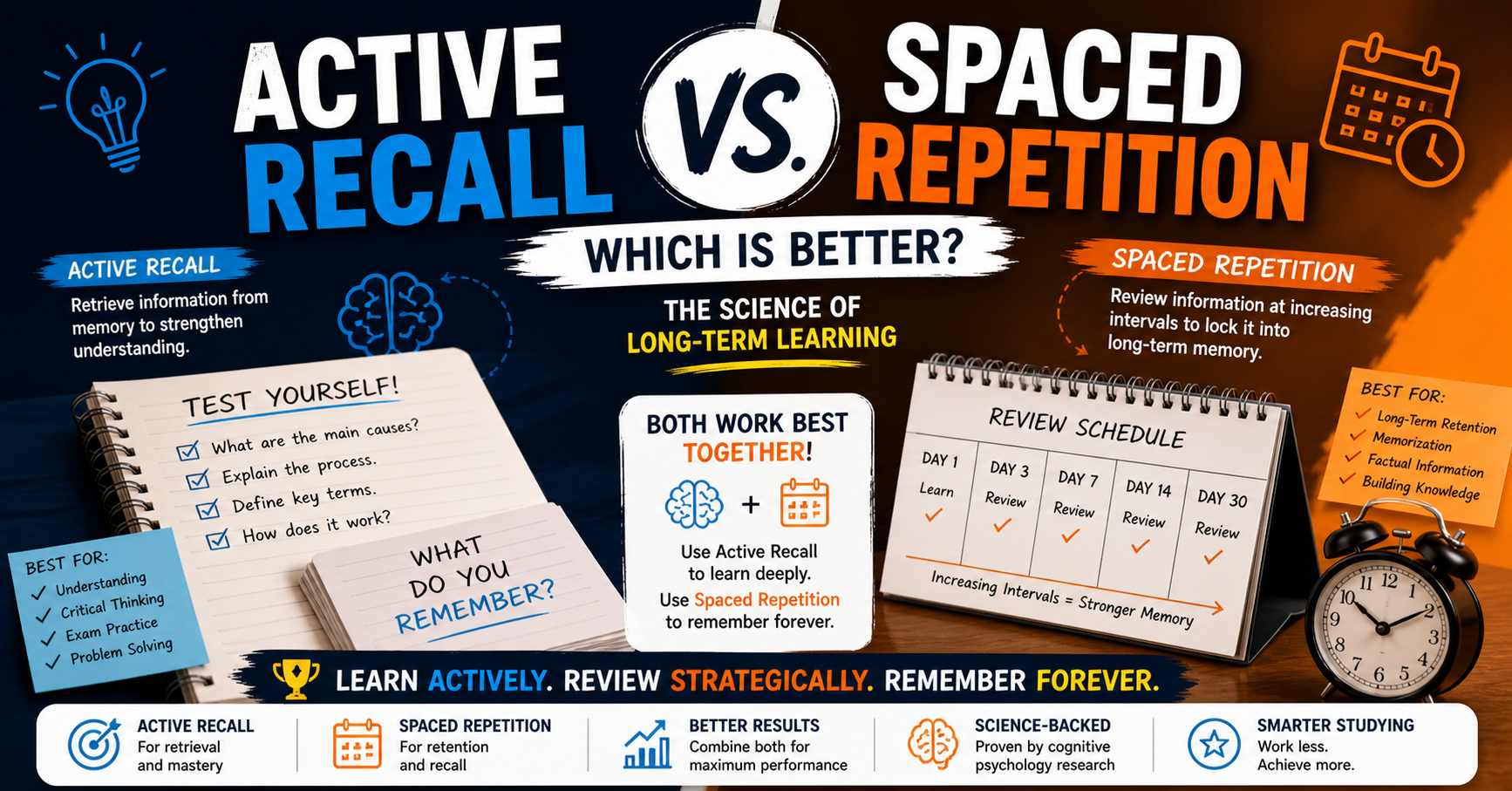
Every student dreams of a study method that guarantees long-term retention with minimal effort. Two techniques, active recall and spaced repetition, consistently emerge as the gold standard, but the debate rages on: which one truly reigns supreme?
In the quest for academic excellence, the greatest challenge isn’t learning itself, but overcoming the natural tendency to forget. The German psychologist Hermann Ebbinghaus first mapped this phenomenon in the 1880s with his "Forgetting Curve," which shows how rapidly we lose new information if we don’t take steps to retain it. Modern cognitive science has since identified powerful strategies to combat this curve, enabling students and professionals to learn more effectively and build lasting knowledge.
Among the most potent of these strategies are active recall and spaced repetition. While often mentioned in the same breath, they are distinct processes that address different aspects of memory formation. Active recall focuses on the *method* of retrieval, while spaced repetition concerns the *timing* of that retrieval. Understanding the nuances between them is the cornerstone of effective learning, transforming study sessions from passive review into powerful, memory-building exercises.
What is Active Recall? The Art of Effortful Retrieval
Active recall, also known as retrieval practice, is the process of actively retrieving information from your memory. It is the polar opposite of passive learning methods, such as re-reading textbooks, highlighting passages, or watching lecture videos. While passive review feels productive, it creates a dangerous "illusion of fluency"—a false sense of mastery without true retention. Active recall forces your brain to work, much like lifting a weight strengthens a muscle. The effort involved in remembering a concept is what solidifies its place in your long-term memory.
Implementing active recall is straightforward. Instead of re-reading a chapter, close the book and summarize its key points from memory. Instead of just looking at flashcards, force yourself to state the answer before turning the card over. Other powerful methods include working through practice problems, trying to teach the concept to someone else (the protégé effect), or simply writing down everything you know about a topic on a blank piece of paper. The key is to create a situation that demands retrieval, not recognition.
The Core Principle: Active recall's power lies in strengthening neural pathways. The very act of struggling to retrieve information makes that information more accessible in the future.
Understanding Spaced Repetition: Timing is Everything
If active recall is the *what*, spaced repetition is the *when*. This technique leverages the "spacing effect," a cognitive phenomenon showing that we learn more effectively when study sessions are spaced out over time. Instead of cramming information into one long session, you review it at increasing intervals. Each review interrupts the forgetting curve at the precise moment you are about to forget the information, reinforcing it in your memory for a longer period.
The ideal review schedule might look something like this: review 1 day after initial learning, then 3 days later, then 1 week, then 2 weeks, and so on. The intervals get progressively longer as the memory becomes stronger. While this can be managed manually with a calendar or the Leitner system (using boxes for flashcards), it is most efficiently handled by Spaced Repetition System (SRS) software. Apps like Anki and SuperMemo use algorithms to automatically schedule reviews for thousands of facts, prioritizing the ones you are weakest on.
Active Recall vs. Spaced Repetition: The Head-to-Head Comparison
The central question—"Which is better?"—is fundamentally flawed. It presents a false dichotomy, as these two techniques are not competitors but powerful partners. Active recall is the engine of memory consolidation; it is the active process you perform during a study session. Spaced repetition is the calendar that tells you *when* to run that engine for maximum efficiency. You can’t have an effective spaced repetition schedule without using an active method of review during those sessions.
To illustrate, passively re-reading your notes on a spaced schedule is far less effective than using active recall, even on a random schedule. The effortful retrieval is the key ingredient. However, performing active recall without a spaced schedule (i.e., cramming) leads to short-term gains but long-term forgetting. The true power emerges when they are combined: using active recall as the method of review within a schedule determined by spaced repetition.
"I used to just re-read my notes for hours and still blank on exams. Switching to active recall with a spaced schedule felt harder at first, but the information actually stuck. It completely changed how I approach my medical school studies."
How It Works: Implementing a Combined Strategy
The Verdict: A Symbiotic Relationship
Rather than viewing active recall and spaced repetition as opposing forces, it is essential to see them as two sides of the same coin. They are symbiotic partners in the journey toward mastery and long-term knowledge retention. Spaced repetition provides the optimal structure for learning, but that structure is useless without the retrieval practice that active recall provides. One is the strategic plan, the other is the tactical execution. When you apply active retrieval practice at optimally spaced intervals, you create the most formidable learning system known to cognitive science.
The Winning Formula: Use active recall as the engine for your study sessions, and use spaced repetition as the roadmap that tells you when and where to drive.
Unlock Your Academic Potential Today
Leverage expert writing and research to achieve your learning goals faster.